



ODEX
Drill and case deep holes simultaneously in all types of formation
Overburden Drilling
As much as 90% of the land surface of the earth is covered with loose, unconsolidated material such as soil, clay, silt, sand, gravel, and boulders, which varies in depth from a few centimeters to hundreds of meters.
Drilling through this so-called overburden is often problematic, due to the tendency of the earth to cave in behind the drill bit. This makes it difficult to retrieve the drill string after the hole has been drilled. In practice, the bore hole is often lost before a casing tube can be inserted to support it.
Other problems are caused by cavities or porous ground, which interfere with the circulation of the flushing medium and prevent the drill cuttings from being flushed out of the hole.
In places where overburden strata are mixed, or when the ‘drillability’ is unknown, it is difficult for the driller to decide what tools to use to get the best overall results without risking the loss of equipment in the hole.
The ODEX Method
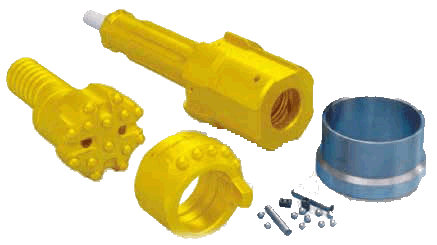
ODEX equipment enables you to drill and case deep holes simultaneously in all types of formation, even those with large boulders. Casing diameters from 114mm (ODEX 90) to 273 mm (ODEX 240) can be used – 90 and 240 in the ODEX code stands for pilot outer diameter.


1
2
3
4
When drilling starts, the ODEX reamer swings out and reams the pilot-hole wide enough for the casing tube to slide down behind the drill bit assembly.
When the required depth is reached, rotation is reversed carefully, whereupon the reamer swings in, allowing the drill bit assembly to be pulled up through the casing.
Casing tubes that are to be left in the drill hole should be sealed at the bottom of the hole by means of cement grout or some other sealing agent.
Drilling continues to the desired depth in the bedrock using a conventional drillstring.


